OSHA's sign standard, 29 CFR 1910.145, sorts accident prevention signs into classes. Danger, Caution and safety instruction signs each have their own job and their own colors.
What 1910.145 says
Three classes cover most of a warehouse floor.
Danger, 1910.145(c)(1)(ii): "All employees shall be instructed that danger signs indicate immediate danger and that special precautions are necessary."
Caution, 1910.145(c)(2)(i): "Caution signs shall be used only to warn against potential hazards or to caution against unsafe practices."
Safety instruction, 1910.145(c)(3): "Safety instruction signs shall be used where there is a need for general instructions and suggestions relative to safety measures."
Danger
Danger means immediate danger. Save it for hazards your team rates as immediate.
Caution
Caution covers potential hazards and unsafe practices, and the rule says "only" those. OSHA also requires that "All employees shall be instructed that caution signs indicate a possible hazard against which proper precaution should be taken." (1910.145(c)(2)(ii))
Safety instruction
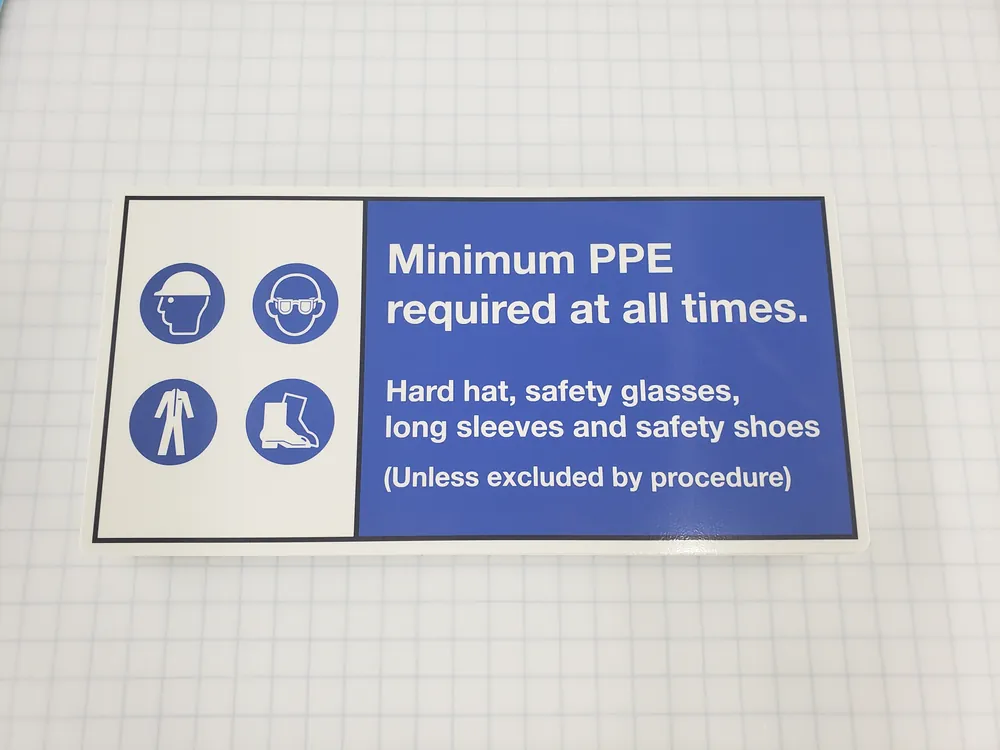
Safety instruction signs carry general safety rules. A PPE reminder at a production door is the kind of message that belongs here.
The colors OSHA sets
- Danger: red, black and white. Under 1910.145(d)(2), the shades must match the color samples in the ANSI tables the rule references.
- Caution: "The standard color of the background shall be yellow; and the panel, black with yellow letters." Then: "Any letters used against the yellow background shall be black." (1910.145(d)(4))
- Safety instruction: "The standard color of the background shall be white; and the panel, green with white letters." Then: "Any letters used against the white background shall be black." (1910.145(d)(6))
The rule also covers the sign itself: "All signs shall be furnished with rounded or blunt corners and shall be free from sharp edges," as well as burrs, splinters and other sharp projections (1910.145(d)(1)).
Where ANSI Z535 adds Warning and Notice
OSHA's standard has no Warning or Notice class. ANSI Z535 adds both.
Your EHS team decides which format your site follows and which edition it works from. We build the signs to the format you specify.
Common mistakes
Danger on everything
When every hazard gets a red Danger header, nobody can tell which hazards are immediate. Keep Danger for immediate hazards and move the rest to Caution or safety instruction.
Mixed designs
For Danger signs, OSHA says: "There shall be no variation in the type of design of signs posted to warn of specific dangers and radiation hazards." (1910.145(c)(1)(i)) A building with three generations of Danger signs works against that. Pick one design and replace the outliers.
Faded signs
OSHA ties the colors to specific samples. A Danger sign faded to pink, or a Caution sign gone pale, no longer shows the colors the rule describes. Check signs that get daylight from dock doors and windows first.
Signs without training
Both the Danger and Caution rules require employees to be told what the sign means. When a new sign goes up, tell the crew in that area what it means.
The wrong class for the message
"Keep this area clean" on a yellow Caution sign dilutes the Caution signs that matter. General rules belong on safety instruction signs.
Sign walk-through checklist
Take a floor plan and a phone camera. At each sign, check:
- Class: Is the hazard immediate (Danger), potential (Caution) or a general rule (safety instruction)?
- Colors: Do they match the class? Red on Danger, yellow and black on Caution, green on safety instruction.
- Condition: Is it faded, scratched, peeling or hard to read from where people stand?
- Design: Does it match the other signs of its class in the building?
- Edges: Are the corners rounded or blunt, with no sharp edges, burrs or projections?
- Placement: Is it at the hazard, in the sight line, and clear of racking, stacked pallets and doors?
- Training: Does the crew in that area know what the sign means?
Photograph every sign that fails and mark its spot on the floor plan. That marked-up plan is your replacement list.
Need signs made to your format?
ANP Graphics Inc. makes Danger, Caution, safety instruction and ANSI Z535-format signs for warehouses and plants across Lake County and the I-94 corridor, from our shop at 3420 Grand Ave in Waukegan. Your EHS team decides what the site needs. We make the signs to that spec and can install them.
See our OSHA and ANSI safety signs. Forklift crossings and walkways often need signs and floor graphics together; see forklift and pedestrian traffic signs and floor marking.
Send your sign list or marked-up floor plan for a quote or call 847-336-4515.